
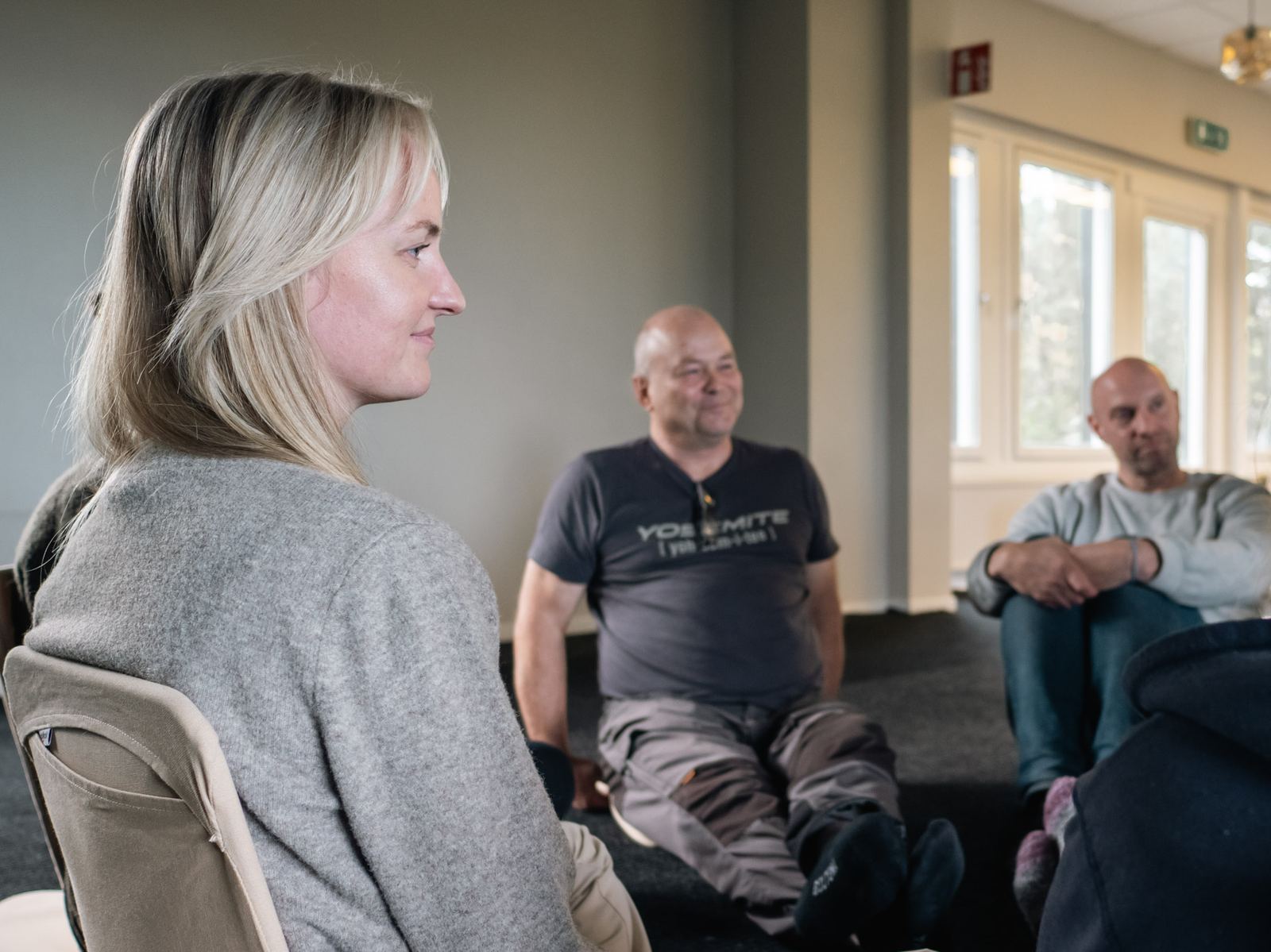
How we think about the week
The week is built from what you do and experience yourself, rather than from lectures you sit and listen to. You are given no schedule in advance, and that is deliberate, because part of the work is not knowing what comes next. Here we tell you how we think about it, so that you know what you are saying yes to.
What you decide yourself
Nothing during the week is compulsory. You are told what an exercise is about before you do it, and then you decide for yourself whether to take part. If you hesitate, that is an answer, and if you say no, that is an answer. Nobody is pushed to experience anything; you are invited to meet what is already there.
You also decide how close you go, how much you share and at what pace, and that holds for the whole week, in the full group, in the smaller groups and when you work in pairs. It holds for the whole week, from the start to the intense days.
The defences we carry
All of us carry ways of protecting ourselves that were needed once, such as making ourselves small or large, adapting, withdrawing, or managing everything alone. Perhaps you recognise some of it. They protected us when something was too much, and they did their job. The trouble is that they stay with us, and that in adult life they often stand in the way of contact with other people and with ourselves, without our noticing it.
The week is about seeing them clearly enough that the grip loosens a little. It is about seeing yourself with kindness, with no demand to perform. The roles we step into are tools we once needed, and not who we are.
An order built for a reason
The week has an order to it, and that order is not random. One thing prepares the way for the next, and there are reasons behind how we have arranged it, but what comes when is something we say on site. So there is nothing you need to prepare for.
It is not a secret for the sake of being secret. Not knowing what is coming means that you are where you are, instead of preparing for the next thing, and that is a large part of the work.
The body first
Most of what we work with cannot be learned by reading. Perhaps you have understood a pattern in yourself completely and still gone on doing exactly what you have always done, because it sits somewhere other than in your thinking. So we practise it in the body, and breath, movement, voice and stillness are every bit as much tools as conversation is.
Much of the work happens in a group, because it is in meeting others that the patterns show themselves, and because something happens in you when you hear another person say the very thing you have carried without finding words for it. Why we work in groups is on the page What we rest on.
The tools
About the words therapy and therapist. What we hold is a course in personal development and self-knowledge. The methods we work with, on the other hand, come largely from therapeutic traditions, and some of them carry it in their names, such as body psychotherapy. A method having its origin in a form of therapy does not make the week psychotherapy. The group leaders and course leaders all have therapeutic training, but the routes there look different, and you will find each person under Who we are. We make no diagnoses, we treat no illness and we replace no care you already have. What you work with here is your own experience.
Here are the methods the week is built from, under their real names, so that you can read up on them if you want to. Several of them come from therapeutic traditions and carry it in the name. The tools come from therapy, but the week is personal development. Which ones are used when is something you learn on site.
- Inquiry
- A kind of talking meditation. The same question is asked over and over, “Who am I?” for instance, and at first the answers come from your thoughts, while further in they begin to come from somewhere else. The question became known through the Indian teacher Ramana Maharshi, and the point is to become less attached to the idea that the answers and the authority lie outside you.
- Body psychotherapy
- Work with what the body has held on to. Tension and posture often carry what words cannot reach.
- Bioenergetics
- Exercises in which breath, movement and the positions of the body are used so that feelings that have got stuck can move again.
- Breathwork
- Directed breathing that changes your inner state, so that what you otherwise cannot reach becomes available.
- Expression exercises
- Being able to give voice to anger, grief or fear in a setting where it is allowed and where someone stays with you throughout.
- Dance and movement
- The body first and the thinking after. A way past what analysis already has an answer for.
- Mindfulness
- Practised presence. Noticing what is going on in you without immediately doing something about it.
- Exploratory conversation
- Conversation with a leader or in pairs, where the question matters more than the answer.
- One-to-one sessions
- Time alone with a leader, apart from the group, when you need it.
- Group sessions
- In the full group and in smaller ones. Each person shares what they want to share, and listens to the others.
- Psychodrama
- Acting out a situation from your own life with the help of the others in the group, so that you get to see it from the outside rather than from within.
- Family constellations
- A way of seeing your own family from the outside, with the help of the others in the group. Used in Step 2.
- Meditation
- Stillness as a frame around everything else. Not an end in itself, but a place to put the day down.
Why we start on the inside
We start from the idea that the inner and the outer belong together. Rather than tending to a symptom where it shows itself, we look for what it comes out of.
That does not mean the symptom is imagined, and certainly not that you brought it on yourself. It means that the body, the feelings and what you have lived through are connected, so that work in one place shows up in the others.
The methods come from several traditions, some old and some new, and they have been adjusted over the years to fit the lives people actually live today.
A few themes recur during the week.
- The inner child
- The drama triangle, the pattern of victim, persecutor and rescuer
- Boundaries
- Feelings and needs
- Family relationships
- Longing
The inner child is about the fact that you still carry with you the person you were as a small child. One of the course leaders might put it like this: “The grown-up you is here, but so is the little girl you, the little boy you. Almost as if you can imagine the two of you being on the course together.”
And boundaries, yes. You do know that a no to somebody else can be a yes to yourself? Knowing that is one thing and feeling what it is like is quite another, which is why we practise rather than talk about it.
The roots
The foundation was laid by Bengt Stern at Mullingstorp, and he in turn drew on Jung, Stanislav Grof, Martinus and Wilhelm Reich. Among the frameworks used today are Karpman's drama triangle, Rosenberg's Nonviolent Communication, Gottman's relationship research and Chapman's five love languages.
None of the methods is ours. What belongs to the course is the way they are put together, and the week they belong to. More about what the course rests on is on a page of its own.
What it is not
What we do is personal development, not medical care. We make no diagnoses and prescribe nothing.
If you are in treatment at the moment we talk about it in the conversation before you are given a place, along with how you are doing otherwise. A divorce, a loss or a crisis in life, on the other hand, is often the very thing that brings people here.
Nor is it a course where you sit still and listen. Almost everything that happens during the week is something you do yourself.
Read also
The methods are tools, and what matters is what you do with them, so we would rather tell you how we think than what happens when. If there is something you are wondering about that is not written here, get in touch and ask us.
The courses, step by step Step 1 Common questions Who leads it